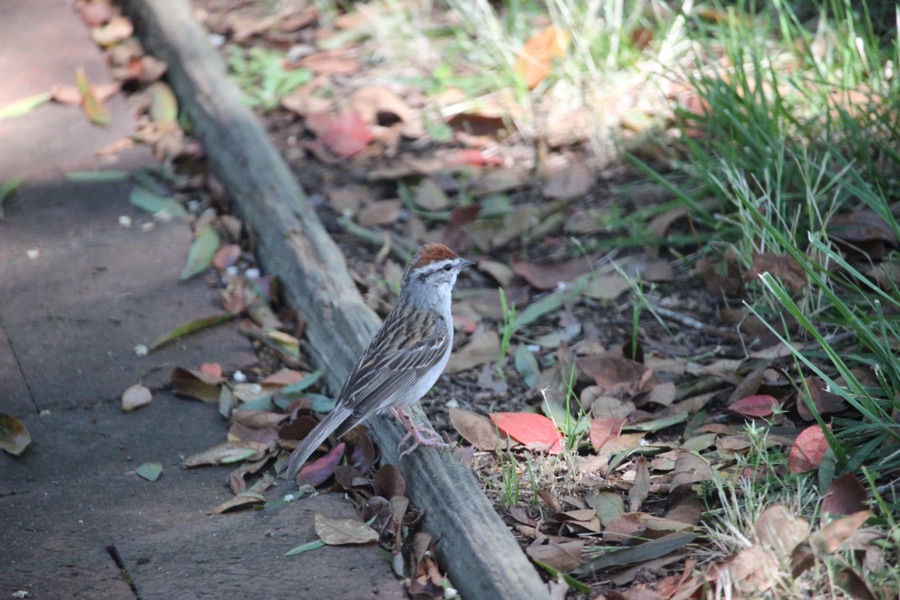
Spizella passerina
The Chipping Sparrow (Spizella passerina) is a species of New World sparrow, a passerine bird in the family Passerellidae. It is widespread, fairly tame, and common across most of its North American range.
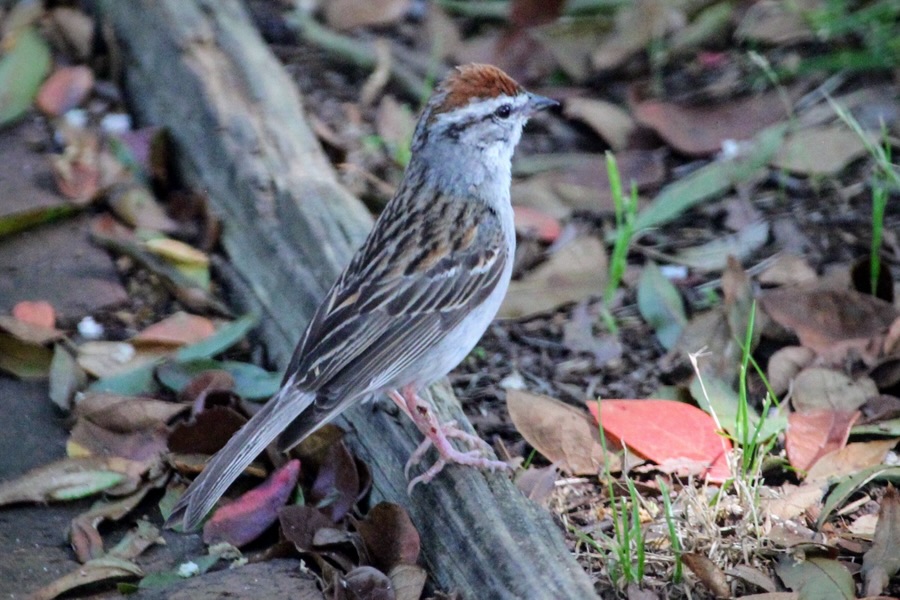
This bird is a partial migrant with northerly populations flying southwards in the fall to overwinter in Mexico and the southern United States, and flying northward again in spring.
It molts twice a year. In its breeding plumage it has orangish-rust upper parts, gray head and underparts and a distinctive reddish cap. In non-breeding plumage, the cap is brown and the facial markings are less distinct. The song is a trill and the bird has a piercing flight call that can be heard while it is migrating at night.
They mostly forage on the ground for seeds and other food items, as well as clambering on plants and trees, feeding on buds and small arthropods. Here in the East, they breed mainly in woodland, farmland, parks, and gardens. [We saw this Chipping sparrow as we left The Farmhouse on the way to The Trailhead Store.] Breeding starts in late April and May and the nest is often built in a tree.
The chipping sparrow feeds on seeds year-round, although insects form most of the diet in the breeding season. Spiders are sometimes taken. Throughout the year, chipping sparrows forage on the ground in covered areas, often near the edges of fields.
The Chipping Sparrow although common in the area is not normally observed by the Stowe Birding Club which track and monitor the birds using their bird houses strategically placed around the Stowe property. [This one Coleman spotted first a short distance from where we were walking. He loves to watch the birds and tries to keep a squirrel out of our bird feeder at home.]
Photo Credit:©️2025 Deb L. Waters … All Rights Reserved.
Camera: Canon EOS Rebel T3i with Canon EF-S55-250mm lens and Altura UV & CPL filter attachments.
Location: The Village at Stowe; Daniel Stowe Conservancy; Belmont, North Carolina, USA
God Bless. Looking up or looking down you might spot a bird fascinating enough to watch. Maybe even capture their likeness with your camera. Thank you for visiting and sharing your time and thoughts with us. I appreciate y’all very much.

 Gfpacificbee’s Insights & photography
So we’re seeing it because of Coleman’s sharp eyes, …. It’s lovely to hear of younger ones being interested in nature., … and that’s a gorgeous bird Deb, and thank you for the info, …💫
LikeLiked by 1 person
Thank you Penn! His eye are much better than mine. He does love nature and prefers the outdoors.
LikeLiked by 1 person
That’s a lovely one. I like that russet cap.
LikeLiked by 1 person
Thank you!
LikeLiked by 1 person
Wonderful little bird. Love the hair colour and haircut
LikeLiked by 1 person
Thank you Brian! Have a good day.
LikeLiked by 1 person