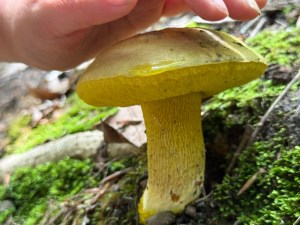
Today as Coleman and I hiked along Timberline Trail at Anne Springs Close Greenway we saw several groups of Mushrooms. Several of the hikers in the hiking club enjoy taking photos of mushrooms. Some refer to them as shrooms.
A Mushroom or toadstool is the fleshy, spore-bearing fruity body of a fungus. They are typically produced above ground, on soil, or on its food source. Most mushrooms have a stalk (aka a stem), and a cap, which is usually disc shaped.
The mushroom helps the tree extract minerals and water from the soil. In exchange, the tree supplies the mushroom with sugar compounds. An interesting fact is that mushrooms are genetically closer to humans than plants. You might wonder how that can even be possible. Well, I wonder that too. It is something I never knew before. It is always beneficial to keep learning new things. Below is a list of amazing facts regarding mushrooms.
- Fungi breath oxygen and exhale co2.
- More than 80% of the earth under your feet is mycelium.
- The mushroom is the tip of the iceberg & is the fruity body of the mycelium.
- The fruity body makes up less than 5% of the organism.
- Mushrooms spores can survive the vacuum and radiation of space.
- Death Cap is one of the most deadliest organisms on the earth.
- psilocybin mushrooms (magic mushrooms) are being researched at John Hopkins University to treat depression, addiction, and many other psychological problems.
- Mushrooms taste good and are free.
I try my best to make sure that Coleman, my grandson, does not touch any mushrooms we see out on the trails. One question to ask: “Is it okay to Touch a mushroom?” There are many common mushrooms which contain toxins, so one needs to be cautious about touching them. It is important not to touch mushrooms growing in the wild. Why you might ask? They may be rare species which should not be damaged. It is difficult to tell if a mushroom is toxic, so it is pertinent to instruct your children to not touch or play with mushrooms. Mushrooms are typically fragile; therefore, it is best to leave them untouched. Touching them may damage or discolor them dye to the oils that are present naturally on our skin.
God Bless. If you come across wild mushrooms, think twice before touching them. You never know the harm that touching them might cause. Thank You for stopping by. I appreciate y’all.


 Gfpacificbee’s Insights & photography