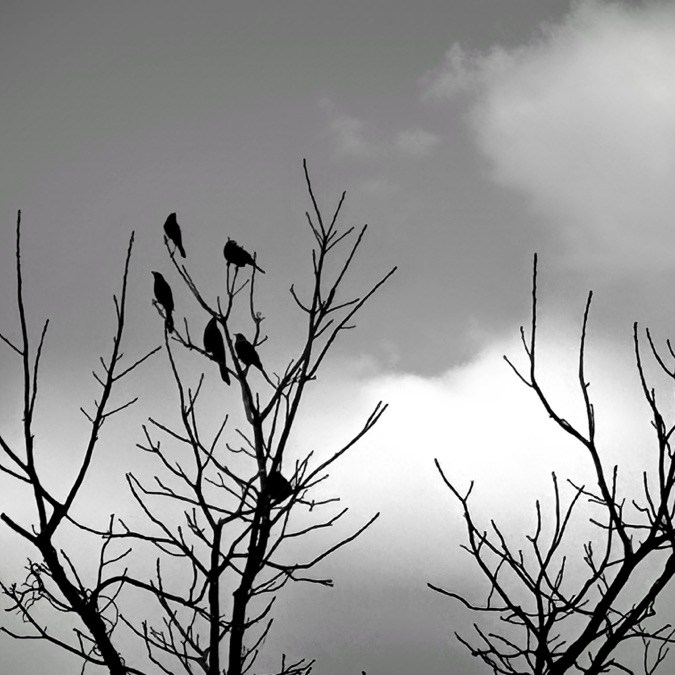
What do you see when you look up into the Trees? Do you just see the leaves and branches? Or do you perhaps see a variety of birds singing their songs. This week we not only have spotted a few birds perched in the trees, but also squirrels fretting to and fro from branch to branch and tree to tree. Here is what we’ve managed to see and capture in monochrome.
God Bless. Thankful He watches over every living thing; the birds, squirrels, and you and I. Take Care. Enjoy the Outdoors and your weekend. Thank you for sharing your time and thoughts with us. I appreciate y’all very much.
Muscovy Duck (Cairina moschata) is a duck native to the Americas. Small wild and feral breeding populations have also established themselves in the United States, particularly in Florida, Louisiana, Massachusetts, the Big Island of Hawaii, South Carolina, as well as in many other parts of North America, including southern Canada.
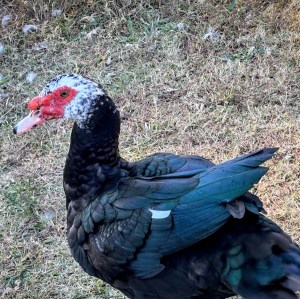
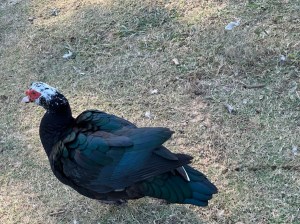
Black Muscovy Duck
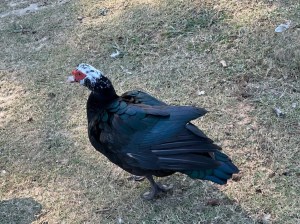
Muscovy Ducks are large with the males growing to about 76 cm (30 in) long, and weighing up to 7 kg (15 lb). The females are relatively smaller, and only grow to approximately 3 kg (6.6 lb), roughly half the males’ size. They are predominantly black and white, with the back feathers being iridescent and glossy in males, while the females are more drab. The amount of white on their neck and head vary , as well as their bill. Their bill can be yellow, pink, black, or any mixture of these colors. (The Muscovy Ducks we saw all had a pinkish bill with one having a touch of black on the end.)
Black Male Muscovy Duck
The Muscovy Ducks are a non-migratory species normally inhabits forested swamps, lakes, streams and nearby grassland and farm crops, and often roosts in trees at night. ( The Muscovy Ducks we saw are located near Patterson Pond at Anne Springs Close Greenway in Fort Mill, South Carolina.)
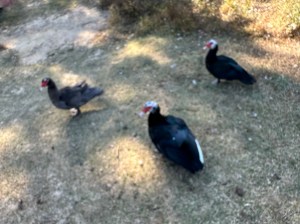
Male and Female Muscovy Ducks
Their diet consists of plant material ( such as the roots, stems, leaves, and seeds of aquatic plants and grasses, as well as terrestrial plants obtained by grazing or dabbling in shallow water for small fish, amphibians, reptiles, crustaceans, spiders, insects, millipedes, and worms.
Black Male Muscovy Duck
Muscovy Ducks, one of the oldest species of fowls domesticated in the world, have several spiritual meanings associated with them. They are associated with love and relationships in some cultures and with luck, prosperity, and even new life and fertility in others. The ducks also represent inner strength and courage. thethe Celtic culture that if you dream of a Muscovy duck or spot it while awake, it’s a sign to trust your intuition and strength and not give up in the face of challenges. According to Celtic culture if you dream of a Muscovy duck or spot it while awake, it is a sign to trust your intuition and strength and not give up in the face of challenges.
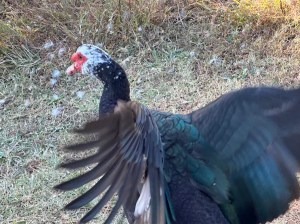
Black Muscovy Duck Flapping its wings after coming out of the water.
The Egyptians believe the Muscovy duck has healing powers and can resurrect the dead, making it a sacred animal. The Egyptian culture sees Muscovy ducks as a symbol of starting afresh. Therefore, seeing a Muscovy duck in your dream is interpreted as a sign of resurrection.
We enjoyed watching the Black Muscovy Ducks swimming in Patterson Pond, as well as them flapping their wings as they came out of the water, shaking the water off to dry themselves.
Location: Patterson Pond; Crandall Bowles Children’s Farm; Greenway Stables and Farm Entrance; Anne Springs Close Greenway; Fort Mill, South Carolina, USA
God Bless. Thank you for visiting and sharing your time and thoughts with us. I appreciate y’all very much.
The American Robin (Turdus migratorius) is one of the most familiar birds in South Carolina and Southern North Carolina. It is a migratory bird of the Turdidae thrush family. It is commonly spotted in forests, woodlands, suburban areas, gardens, and parks. They are known to build their nests on trees, and sometimes even on man-made structures such as porches and garages.
The American Robin is very energetic and spry. It flits about on the ground searching for food. They fly to and fro from the trees to electrical wires just outside our back patio. It is mostly active during the daytime and gathers in large flocks at night. We can hear their songs way before we can spot the in the sky, in the trees or on our electrical lines.
The American Robin’s diet generally consists mainly of such delicacies as earthworms, beetle grubs, caterpillars, and grasshoppers, and a large portion of wild and cultivated fruits and berries.
We continuously hear them singing throughout the afternoon as we sit out back and Coleman plays in his sand Turtle. They are often among the first songbirds to sing as dawn rises or hours before, and last as evening sets in. One fact I learned recently is that the American Robin sings when storms are approaching and again when the storms have passed.
Interesting Facts about the American Robin are that they are protected throughout the United States by the Migratory Bird Treaty Act. They are considered a symbol of Spring. A noted Quebec superstition is whoever sees the first Robin of Spring will have good luck. It is believed by some that the first robin of spring means it is a promise of new beginnings and renewal similar to how plants begin to grow and bloom in springtime.




 Gfpacificbee’s Insights & photography