
Seahorses
Seahorses are truly captivating creatures. They vary in size from the tiny pygmy seahorse, which can be as small as 0.5 inches (1.3 cm), to larger species like the Big-belly seahorse, which can reach up to 14 inches (35 cm) in length. The Seahorses you see in this aquarium are on the rather small side of the size range.
In this first image you’ll need to look closely to spot the Seahorse (s).
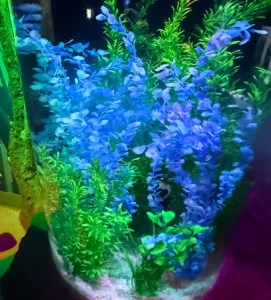
Seahorses are unique marine bony fish belonging to the genus Hippocampus. They’re best known for their horse-like heads and upright swimming posture. Did you know that there are approximately forty-seven (47) recognized species of Seahorses found worldwide? I didn’t know that before seeing and learning about them at the aquarium.
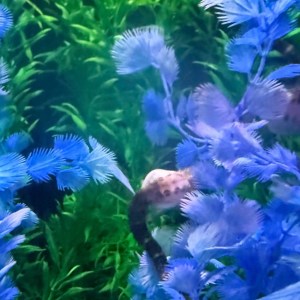
Seahorses may not look like the normal typical fish you would expect to see, but they are indeed true fish equipped with swim bladders for buoyancy and gills to breathe. They feature a horse-like head at a right angle to their body, an exoskeleton of bony plates instead of scales, independent eye movements (which allows them to look in two (2) different directions at the same time, and also feature a coronet (a crown-like ridge) on their head.
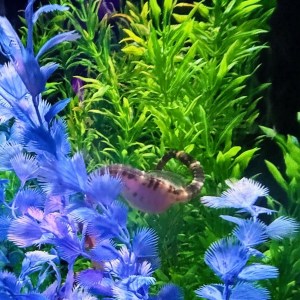
Sea Life Aquarium
Here are some interesting facts about Seahorses:
- Seahorses are the only fish species where the male carries the eggs in a specialized brood pouch, similar to a kangaroo’s. The female deposits her eggs into a special brood pouch on the male’s abdomen, where he fertilizes and carries them for 2 to 4 weeks until birth.
- Seahorses lack both teeth and a stomach. Their food passes through their digestive system very quickly. In doing so, they must eat practically constantly. In so doing they consume nearly 3,000 tiny crustaceans and brine shrimp a day by sucking them up through their tubular snouts like a vacuum.
- Seahorses are the slowest moving fish. Their stiff bodies and small fluttering dorsal fins make them terrible swimmers. The top speed for a dwarf Seahorse is about 1.5 meters (5 feet) per hour.
- Seahorses use their prehensile tails to keep from being swept away (just like an anchor) by strong ocean currents or fatigue. Seahorses wrap their flexible tails around seaweed coral, or even each other to act similar to a hitching post.
- Seahorses have independent eye movement. In other words, they can look in front of themselves and backwards at the exact same time. Or even any two different directions completely in order to watch out for predators and spot prey.
Did you learn anything new today? I sure learned new information about Seahorses after visiting Sea Life Aquarium.
Click on image to enlarge.
Photo Credit: Copyright ©️2026 Deb L. Waters … All Rights Reserved.
Camera: Apple iPhone 16 Pro Max
Location: Sea Life Charlotte-Concord Aquarium; Concord Mills; Concord, North Carolina, USA
God Bless. Have a pleasant and funtastic week. Thank you for visiting and sharing your time and thoughts with us. I appreciate y’all very much.

