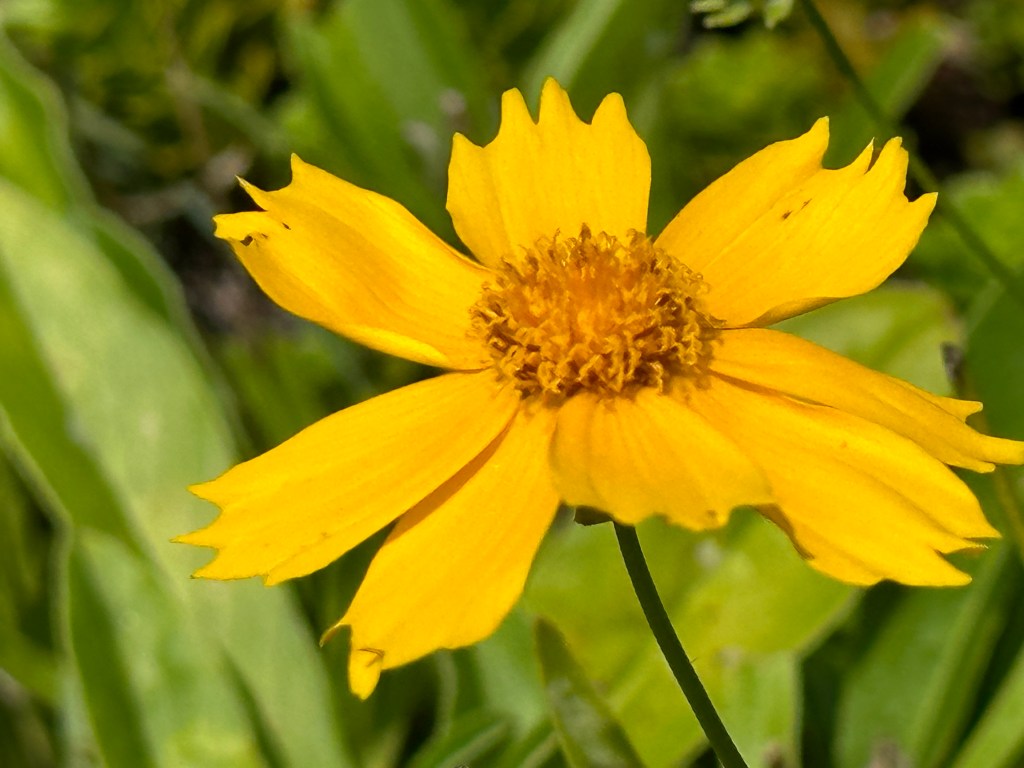
Coreopsis lanceolata is a North Americanspecies of tickseed in the family Asteraceae. It is native to the Eastern and Central parts of the United States, naturalized in Canada, the Western United States, Mesoamerica, South America, South Africa and Eastern Australia. It is found in open woodlands, prairies, plains, glades, meadows and savannas.
Rudbeckia hirta is a short-lived perennial that should be treated as an annual. It may likely endure few winters, but will often self-seed prolifically. The flowers are showier than other Rudbeckia species and have been widely hybridized. (Clemson.edu)
Dale of The Cosmic Photo Challenge prompt is Freestyle this week.
Since this is freestyle week I decided to let you visit with me on one of the hikes Coleman and I took this past week. This hike was a little bit different in that we had my daughter, Coleman’s mom, along with us. On Tuesday we needed to be out of the home for awhile because a pest control company was going to come in and spray per the Complex management.
Therefore, we decided to go hiking in one of Coleman’s favorite places. The place we chose was Anne Springs Close Greenway about twenty minutes or so from our residence. Mind you now my daughter is not fond of hiking at all. When we arrived, we should them my membership card and proceeded to park. We thought Trisha, my daughter, was just gonna sit and relax near the canteen while Coleman and I hiked. It didn’t exactly go like we had thought. You see, Trisha brought her dog along with on our adventure ( he had to be out of the home as well).
Lake Haigler
Chewbacca, Trisha’s dog, decided he wanted to hike with us, therefore she had to tag along. We walked down to the lake and proceeded along the trail, Lake Haigler Loop, around the lake.
Haigler Loop
Coleman loves to run along the trail. I prefer a slower pace since I normally take many photos along the trail of the various sites we see. Often we observe different angles around the lake, seeing flowers, butterflies, sometimes turtles, bees, and even dragonflies.
Brazilian Vervain (Verbena brasiliensis)
At other times we see amazing reflections in the water.
Reflections in Lake Haigler
I love seeing various creatures feasting on the nectar of wildflowers her at the Greenway.
Black Swallowtail, Eastern Bumblebee, and Delta Flower Scarab Beetle feasting on Buttonbush Cephalanthus occidentalis.
Further down the trail as we hike around the lake I notice what appears to be a shape of a triangle formed with the reflections in the lake.
Triangle formation from the water reflections. Surrounding Tree Reflections plus water shimmering
As we keep going I slow down observing butterflies flittering to and fro. Naturally I stop to snap a photograph. Meanwhile, my daughter’s trying to convince me to stop taking pictures. Guess what? She didn’t convince me, not one single solitary moment.
Eastern Tiger Swallowtail Pearl Crescent Butterfly
Next on our hike we come across a dragonfly and several turtles along the edge of the lake.
Widow Skimmer Dragonfly Turtles sunbathing on a log
By this time my daughter is tired and wants to get this hike over with. Naturally, Coleman and Chewbacca want to keep going. They’re enjoying the outdoors adventure. Hence, we keep chugging along.
Water Reflections Water Ripples
After awhile we decide to pull up a seat and relax a bit before finishing our hike. But first there’s more to observe as we near the picnic tables along the backside of the lake.
Trisha, Chewbacca, with Coleman leading the way. [He knows the trails better than most adults]. Ngaro Wīwi Priocnemis monachus delighting on Angelica genuflexa
Finally to a spot to snack relax near the water’s edge.
I hope you enjoyed trekking along with us on our hike around Lake Haigler. God Bless. Thank you for sharing your time and thoughts with us. I appreciate y’all.
Slender Vervain is a perennial that spreads by rhizomes and is native to South America. Is an annual north of zone 7 but needs winter protection in that zone. It has naturalized from southeastern North Carolina to Florida and is very tolerant of heat and drought.
These Verbena rigida are in the garden in front of The Schiele Museum of Natural History and Planetarium in Gastonia, North Carolina.
The Scilla Peruviana is also known as the Portuguese Squill. It is a spring-blooming bulb with striking, lavender-blue flowers. The flower heads can be as large as a softball, with star-like florets that open gradually over a period of 3 weeks or more. The plants have long, strappy leaves similar to a hyacinth, and grow 12-20” tall.
Eastern Tree Caterpillar nests are commonly found on wild cherry, apple, and crab apple, but may be found on hawthorn, maple, cherry, peach, pear and plum as well. There is one generation of the Eastern tent caterpillar per year. The insects overwinter as egg masses on twigs, and they hatch in April. They turn into moths which are reddish-brown with two pale stripes running diagonally across each forewing. Photinia ‘ Red Robin ‘ P x fraseri also known as the Christmas Berry makes an attractive hedging plant with its glossy red new growth. Wisteria sinensis ‘Cooke’s Purple’Hally Jolivette Cherry (Prunus) is one of the best flower ornamental cherry trees available.
It’s been cold and rainy all week. On Wednesday, Coleman and I decided to try to beat the rain and ventured out to visit Forest at Anne Springs Close Greenway Horse Stables. It was sure cold 🥶 though. However, Coleman enjoyed his time visiting the horses. [Those pictures are saved for another post].
Hanging Planter on the ground at the Gibson House
We spotted these Violet and White Flowers by the Gibson House on the way back to the car whilst trying not to get the camera wet. So naturally I had to capture them with a few snapshots. After all I did have my camera around my neck.




 Gfpacificbee’s Insights & photography