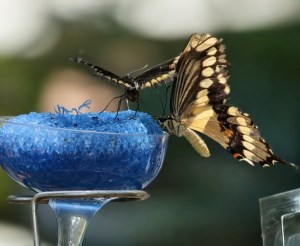
XingfuMama hosts the weekly challenge Whatsoever Is Lovely. The challenge is simple. Just reflect back over your week and see what is lovely, whether a thing or a moment, share in a post what is precious and lovely to you.
This week I am continuing with Whatsoever is Lovely to me; Beautiful Flowers & Butterflies #5. These images were taken on Coleman’s & my recent visit to the Daniel Stowe Botanical Garden in Belmont, North Carolina. The first area we visited was the Butterfly Bungalow. We had not previously visited the Butterfly Bungalowsince the times we’ve visited Daniel Stowe Conservancy before were in the Springtime.
For this post I am focusing on the Spicebush Swallowtail (Papilio troilus), one of the many varieties of butterflies maintained within the Butterfly Bungalow at the Daniel Stowe Botanical Garden.
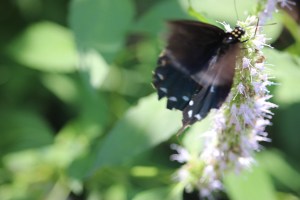
(Papilio troilus)
The Spicebush Swallowtail (Papilio troilus) is a one of the most fascinating butterflies in eastern North America due to its specialized lifecycle, unique hosting plants, and their use of mimicry to survive.
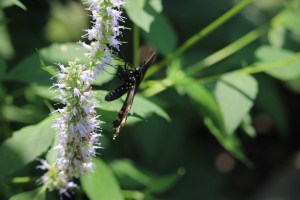
on Anise Hyssop
(Agastache foeniculum)
The Papilio troilus, aka the Spicebush Swallowtail, or Green-clouded butterfly, is a common black Swallowtail butterfly only found in the Eastern United States and Southern Ontario, however, it can sometimes be seen in the American plains states, Cuba, Manitoba, and Colorado. .
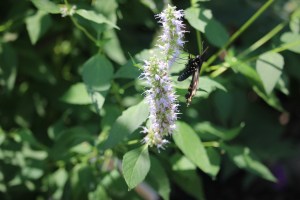
(Papilio troilus)
It is normally found in deciduous woods, or woody swamps. There they can be seen flying low and fast through shaded areas.
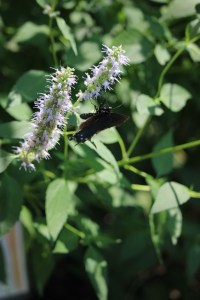
The Papilio troilus has two (2) subspecies, Papilio troilus troilus and Papilio troilus ilioneus. The Papilio troilus troilus is the one seen in this area and pictured in these images. Papilio troilus ilioneus is confined to the Southeastern coastal United States, mainly throughout Florida, along the coast of Georgia, and in places in Texas.
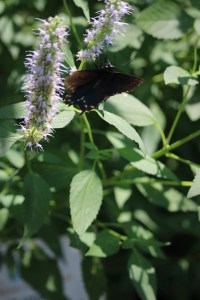
(Papilio troilus)
The primary host plants for the Spicebush Swallowtail are most commonly the Spicebush ((Lindera benzoin) or White Sassafras (Sassafras albidum). Despite their preference to primarily feed Lauraceae plants, they do feed on Anise Hyssop (Agastache foeniculum), especially here in the Butterfly Bungalow. Anise Hyssop is widely known as one of the ultimate “pollinator magnets” that is typically added to gardens.
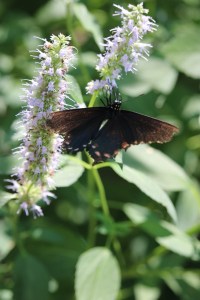
on Anise Hyssop
(Agastache foeniculum)
The Spicebush Swallowtail love the Anise Hyssop for its perfect landing pads. The dense, structural spikes are composed of hundreds of tiny, nectar-rich tubular flowers. The Spicebush Swallowtail can easily grasp the stalks with their legs while their long proboscis probes from bloom to bloom. They also love the Anise Hyssop for its continuous energy. Anise Hyssop has an exceptionally long blooming window,The plant typically produces fresh flowers from June through September.
This blooming season of the Anise Hyssop provides a vital, reliable energy source for late-summer generations of butterflies preparing to reproduce or move through woodland edges.
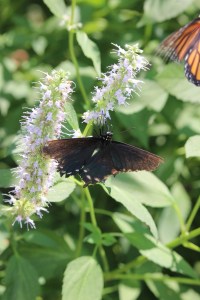
(Papilio troilus)
on Anise Hyssop
(Agastache foeniculum)
Click on images to enlarge.
Whatsoever is Lovely Challenge-2026 Week #38
Terri’s The Flower Hour-2026.09.28
Cee’s Flower of the Day (FOTD)
Photo Credit:©️2026 Deb L. Waters … All Rights Reserved.
Camera: Canon EOS Rebel T7 (2000D) with Canon EF-S55-250mm lens.
Location: Butterfly Bungalow; Daniel Stowe Botanical Garden; Bely, North Carolina, USA
God Bless. Have a lovely weekend filled with love, joy, and laughter. Thank you for visiting and sharing your time and thoughts with us. I appreciate y’all very much.