2026 Whatsoever is Lovely: Beautiful Flowers & Butterflies #5

XingfuMama hosts the weekly challenge Whatsoever Is Lovely. The challenge is simple. Just reflect back over your week and see what is lovely, whether a thing or a moment, share in a post what is precious and lovely to you.

This week I am continuing with Whatsoever is Lovely to me; Beautiful Flowers & Butterflies #5. These images were taken on Coleman’s & my recent visit to the Daniel Stowe Botanical Garden in Belmont, North Carolina. The first area we visited was the Butterfly Bungalow. We had not previously visited the Butterfly Bungalowsince the times we’ve visited Daniel Stowe Conservancy before were in the Springtime.

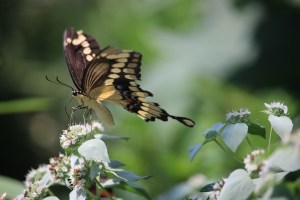
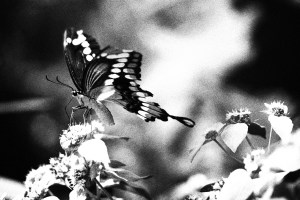
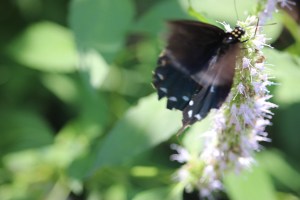
For this post I am focusing on the Spicebush Swallowtail (Papilio troilus), one of the many varieties of butterflies maintained within the Butterfly Bungalow at the Daniel Stowe Botanical Garden.
Spicebush Swallowtail
(Papilio troilus)

The Spicebush Swallowtail (Papilio troilus) is a one of the most fascinating butterflies in eastern North America due to its specialized lifecycle, unique hosting plants, and their use of mimicry to survive.
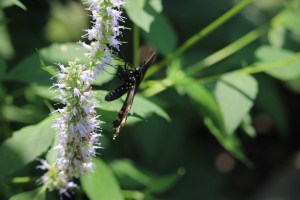
Spicebush Swallowtail
on Anise Hyssop
(Agastache foeniculum)

The Papilio troilus, aka the Spicebush Swallowtail, or Green-clouded butterfly, is a common black Swallowtail butterfly only found in the Eastern United States and Southern Ontario, however, it can sometimes be seen in the American plains states, Cuba, Manitoba, and Colorado. .
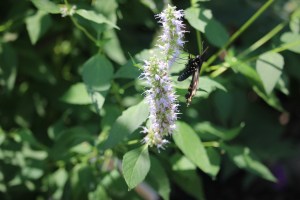
Spicebush Swallowtail
 (Papilio troilus)

It is normally found in deciduous woods, or woody swamps. There they can be seen flying low and fast through shaded areas.
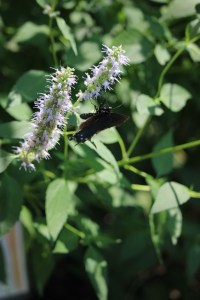
Spicebush Swallowtail 

The Papilio troilus has two (2) subspecies, Papilio troilus troilus and Papilio troilus ilioneus. The Papilio troilus troilus is the one seen in this area and pictured in these images. Papilio troilus ilioneus is confined to the Southeastern coastal United States, mainly throughout Florida, along the coast of Georgia, and in places in Texas.
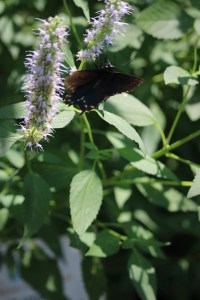
Spicebush Swallowtail
(Papilio troilus)

The primary host plants for the Spicebush Swallowtail are most commonly the Spicebush ((Lindera benzoin) or White Sassafras (Sassafras albidum). Despite their preference to primarily feed Lauraceae plants, they do feed on Anise Hyssop (Agastache foeniculum), especially here in the Butterfly Bungalow. Anise Hyssop is widely known as one of the ultimate “pollinator magnets” that is typically added to gardens.
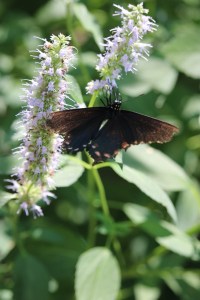
Spicebush Swallowtail 
on Anise Hyssop
(Agastache foeniculum)

The Spicebush Swallowtail love the Anise Hyssop for its perfect landing pads. The dense, structural spikes are composed of hundreds of tiny, nectar-rich tubular flowers. The Spicebush Swallowtail can easily grasp the stalks with their legs while their long proboscis probes from bloom to bloom. They also love the Anise Hyssop for its continuous energy. Anise Hyssop has an exceptionally long blooming window,The plant typically produces fresh flowers from June through September.

This blooming season of the Anise Hyssop provides a vital, reliable energy source for late-summer generations of butterflies preparing to reproduce or move through woodland edges.
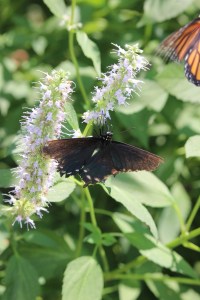
Spicebush Swallowtail
(Papilio troilus)
on Anise Hyssop
(Agastache foeniculum)

Click on images to enlarge. 

Whatsoever is Lovely Challenge-2026 Week #38

Monday Portrait

Macro Monday (MM)

Terri’s The Flower Hour-2026.09.28

Cee’s Flower of the Day (FOTD)

Photo Credit:©️2026 Deb L. Waters … All Rights Reserved. 

Camera: Canon EOS Rebel T7 (2000D) with Canon EF-S55-250mm lens. 

Location: Butterfly Bungalow; Daniel Stowe Botanical Garden; Bely, North Carolina, USA 

God Bless. Have a lovely weekend filled with love, joy, and laughter. Thank you for visiting and sharing your time and thoughts with us. I appreciate y’all very much.
2026 Whatsoever is Lovely: Beautiful Flowers & Butterflies #4

XingfuMama hosts the weekly challenge Whatsoever Is Lovely. The challenge is simple. Just reflect back over your week and see what is lovely, whether a thing or a moment, share in a post what is precious and lovely to you.

This week I am continuing with Whatsoever is Lovely to me; Beautiful Flowers & Butterflies #4. These images were taken on Coleman’s & my recent visit to the Daniel Stowe Botanical Garden in Belmont, North Carolina. The first area we visited was the Butterfly Bungalow. We had not previously visited the Butterfly Bungalowsince the times we’ve visited Daniel Stowe Conservancy before were in the Springtime.

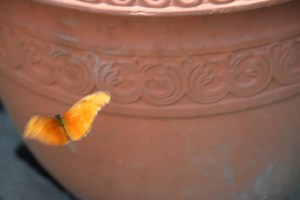
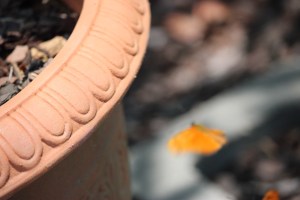
For this post I am focusing on the Dryas iulia, Aka Julia Longwing butterfly, Julia heliconian, the flame, or flambeau.

Dryas iulia

Dryas iulia is often misspelled incorrectly as julia. It is the only representative in the genus Dryas. It is a species of brush-footed butterfly, native from Brazil to southern Texas and Florida. In the summertime it can sometimes be found as far north as eastern Nebraska. They are considered rare immigrants or temporary strays in both North and South Carolina. That doesn’t mean they won’t be spotted though. During the warm summer months, individual adults occasionally migrate or drift northwards from their permanent breeding grounds in southern Florida and southern Texas.

Julia Longwing butterfly

The Julia Longwing butterfly was are known for their striking bright orange wings. They can have black markings, and their have notably long and narrow forewings which gives them that “Longwing” moniker.

Julia heliconian

The Julia heliconian butterflies are extremely fast and erratic fliers; they were quite a challenge to capture with my camera. Their fast movements prevented me from being able to catch all of them clearly, however, I still did managed to catch a few good shots with my Canon.

Julia Butterfly

Besides being very fast fliers, they frequent clearings, paths, and margins of forests and woodlands. They feed on the nectar of flowers, like lantanas (Lantana) and shepherd’s-needle. They drink the tears of caiman, the eye of which the butterfly irritates to produce tears.

the flame

The Dryas iulia butterfly species is real popular in butterfly houses similar to the Butterfly Bungalow at the Daniel Stowe Conservancy. Their popularity is due to its longevity and its activity throughout the day. They were intensely fascinating to watch them zipping to and fro, hither and yonder faster than your (at least mine) eyes could follow them.

flambeau

These pictured here are maintained in the controlled environment of the Butterfly Bungalow inside the Gardens of Daniel Stowe Botanical Garden in Belmont, North Carolina. The Dryas iulia are a featured seasonal resident of the Butterfly Bungalow at Daniel Stowe Conservancy. Since these butterflies thrive in tropical environments, the Garden imports them chrysalides as part of their summer pollinator exhibition. The warm, humid greenhouse enclosure provides an ideal environment for them to fly alongside other native and tropical species like the Zebra Longwing and Malachite.

Click on images to enlarge. 

Whatsoever is Lovely Challenge-2026 Week #38

Terri’s Sunday Stills Monthly Color Challenge-Orange

Sunday Stills Monthly Color Challenge

Photo Credit:©️2026 Deb L. Waters … All Rights Reserved. 

Camera: Canon EOS Rebel T7 (2000D) with Canon EF-S55-250mm lens. 

Location: Butterfly Bungalow; Daniel Stowe Botanical Garden; Bely, North Carolina, USA 

God Bless. Have a lovely weekend filled with love, joy, and laughter. Thank you for visiting and sharing your time and thoughts with us. I appreciate y’all very much.
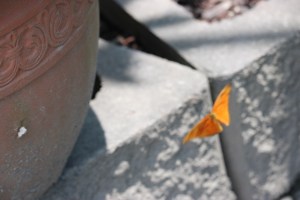
Ragtag Daily Prompt (#RDP): Saturday 2026.08.01 — Bungalow

Butterfly Bungalow

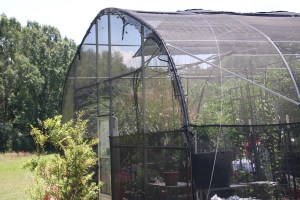
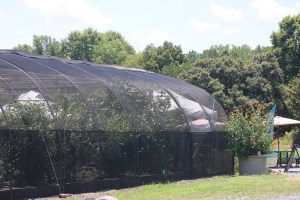
The Butterfly Bungalow at the Daniel Stowe Botanical Garden in Belmont, North Carolina. Not what you’d typically thing of when you think of Bungalow, however, it works great for the many Butterflies maintained within its enclosure as well as the flowers that nourish them.

Click on images to enlarge.

Ragtag Daily Prompt (RDP): Saturday-Bungalow

Photo Credit:©️2026 Deb L. Waters … All Rights Reserved. 

Camera: Canon EOS Rebel T7 (2000D) with Canon EF-S55-250mm lens and Altura UV Filter attachment.

Location: Butterfly Bungalow; Daniel Stowe Botanical Garden; Daniel Stowe Conservancy; Belmont, North Carolina, USA

God Bless. Have a terrific week. Thank you for visiting and sharing your time and thoughts with us. I appreciate y’all very much.
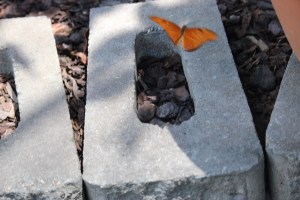
2026 Whatsoever is Lovely: Beautiful Flowers & Butterflies #3

XingfuMama hosts the weekly challenge Whatsoever Is Lovely. The challenge is simple. Just reflect back over your week and see what is lovely, whether a thing or a moment, share in a post what is precious and lovely to you.

This week I am continuing with Whatsoever is Lovely to me; Beautiful Flowers & Butterflies #3. These images were taken on Coleman’s & my recent visit to the Daniel Stowe Botanical Garden in Belmont, North Carolina. The first area we visited was the Butterfly Bungalow. We had not previously visited the Butterfly Bungalowsince the times we’ve visited Daniel Stowe Conservancy before were in the Springtime.

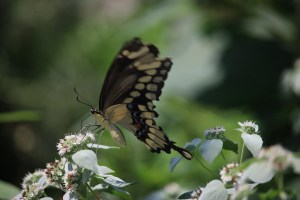
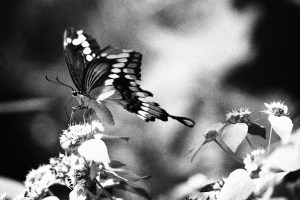
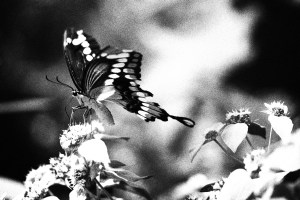
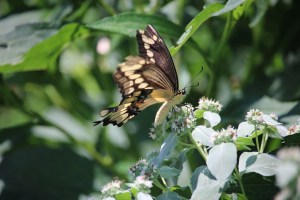
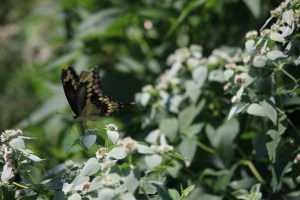
For this post I am focusing on the Giant Swallowtail (Polygonia comma). The Giant Swallowtail is the largest butterfly located in North America. It is known for its black wings with striking yellow stripes and its large wingspan. The Giant Swallowtails can have a massive wingspan of up to six (6) inches long.

Interestingly, their abdomen and outer wings are a light yellow shade with red and blue markings along the bottom of their wings while they have black and yellow stripes directly above their heads.

These Giant Swallowtails (Polygonia comma) are also referred to as Eastern Comma. They can typically be seen in shaded areas or near bodies of water. The Eastern Comma feed on sap, rotting fruit, dung, salt and minerals. They are a confident , aggressive, and social butterfly.

These Giant Swallowtails are feasting on Pycnanthemum incanum, aka Hoary Mountain Mint. The Mountain Mint is a hardy, aromatic perennial in the mint family which is native to eastern North America. It is known for its silvery-white foliage with clusters of small white to lavender flowers that bloom during the summertime. It is an excellent magnifier pollinators like bees, butterflies, and wasps. (I prefer watching the butterflies to bees or wasps.)

These pictured here are maintained in the controlled environment of the Butterfly Bungalow inside the Gardens of Daniel Stowe Botanical Garden in Belmont, North Carolina.

Click on images to enlarge. 

Whatsoever is Lovely Challenge-2026 Week 29

Cee’s Flower of the Day (FOTD)

Photo Credit:©️2026 Deb L. Waters … All Rights Reserved. 

Camera: Canon EOS Rebel T7 (2000D) with Canon EF-S55-250mm lens. 

Location: Butterfly Bungalow; Daniel Stowe Botanical Garden; Bely, North Carolina, USA 

God Bless. Have a lovely weekend filled with love, joy, and laughter. Thank you for visiting and sharing your time and thoughts with us. I appreciate y’all very much.
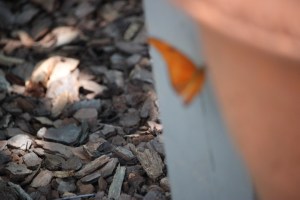
Macro Monday – 2026 July 27

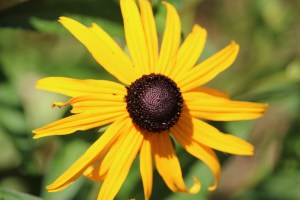
Rudbeckia hirta


Rudbeckia hirta, aka Black-eyed Susan and Yellow coneflower

Click on image to enlarge. 

Macro Monday (MM)

Cee’s Flower of the Day (FOTD)

Photo Credit:©️2026 Deb L. Waters … All Rights Reserved. 

Camera: Canon EOS Rebel T7 (2000D) with Canon EF-S55-250 mm lens and Altura UV Filter attachment. 

Location: Daniel Stowe Botanical Garden; Belmont, North Carolina, USA 

God Bless. Take time to enjoy nature. Admire the beautiful flowers and plants. Have a funtastic week. Thank you for visiting and sharing your time and thoughts with us. I appreciate y’all very much.
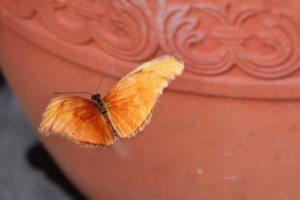
2026 CosPhoChal: Close Up with Butterflies

Dale, the host of the Cosmic Photo Challenge, has challenged us to post a few close-up shots for this week’s challenge. Coleman and I had just recently visited the Butterfly Bungalow watching the butterflies fluttering to and fro from flower to flower feasting on nectar and/or pollen till their hearts content. Therefore, I thought it might be worth it to share a few close-ups with you.

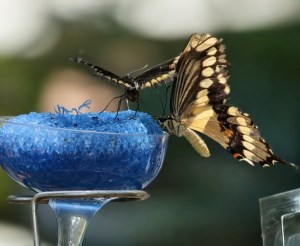
Eastern Giant Swallowtails

First, in the image above we are viewing two Eastern Giant Swallowtails enjoying the tasty delight in the butterfly feeder.

Next, let’s take a closer look at the Butterfly feeder. Not only are the Swallowtails having a delicious feast of the sugar water solution mixed with fruit to provide them with energy, but severe black ants are joining in to sample it as well.

And finally for a close-up view of the Eastern Giant Swallowtails themselves. Observe the delicate line, pattern, and color details in the design of the Swallowtails wings. Notice their distinctive appearance with their prominent antennae that are dark, slender, and distinctively club-tipped. Its legs are also slender, dark, and segmented allowing it to grip the edge of the feeder.

Click on each image to enlarge.

Cosmic Photo Challenge (#CosPhoChal)-Close-Up

Photo Credit:©️2026 Deb L. Waters … All Rights Reserved.

Camera: Canon EOS Rebel T7 (2000D) with Canon EF-S55-250mm and Altura UV Filter attachment.

Location: Butterfly Bungalow; Daniel Stowe Botanical Garden; Belmont, North Carolina, USA

God Bless. Get Outdoors. Be observant of all creatures large and small that call our Earth home. Thank you for visiting and sharing your time and thoughts with us. I appreciate y’all very much.